
One Phone, Two Security Contexts
Why mobile fraud detection must preserve device continuity.
Group-IB published its technical analysis on September 9, 2026. Fraudnode publication date: September 15, 2026.
Lead
A banking transaction can originate from the victim's real phone, use a familiar network and still belong to a fraudulent session.
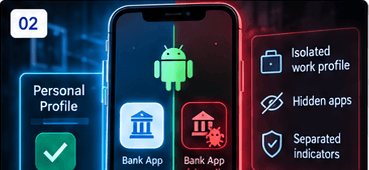
That is the uncomfortable lesson from new research into Gigabud, an Android remote-access banking Trojan. According to Group-IB, operators paired Gigabud with a weaponized application called Vwork to create an Android Work Profile and place a cloned or modified banking application inside that isolated environment. The technique can separate an earlier malware signal in the phone's personal profile from the transaction that follows in the work profile.
The fraud does not defeat every security control individually. It exploits the gaps between them.
For banks, wallets and payment providers, this is an important architectural warning: a device fingerprint is useful only when it is part of a continuous, cross-layer account of the session.
What Group-IB observed
Group-IB's technical analysis describes Vwork as a modified fork of Shelter, an open-source application that legitimately uses Android's Work Profile feature to isolate or duplicate applications.
The malicious version changes the control model. Instead of relying primarily on actions performed by the device owner through a visible interface, Vwork exposes functions that another application can invoke. Group-IB identified Gigabud samples containing specific commands for initializing Vwork, cloning applications and reporting the cloned applications back to the operator.
The reported sequence is broadly as follows:
- A victim is persuaded to install a fake application outside an official app store. Lures observed by Group-IB impersonated airlines, tax authorities and government services.
- Gigabud requests powerful permissions, including Accessibility access and permission to draw over other applications.
- The malware inventories installed applications, allowing the operator to identify relevant banking targets.
- Fake overlays can capture banking credentials and the device lock-screen code.
- Vwork creates an isolated Work Profile and installs a cloned or modified banking application inside it.
- The operator conducts transactions through remote control or automated on-screen actions while concealing activity from the user.
Android's separation model is not itself a vulnerability. Application sandboxing and profile isolation are legitimate security features. Google's documentation explains that Android isolates application data and code execution, while enterprise Work Profiles are designed to keep work applications and information separate from personal data. In this case, the attacker turns that separation into an evasion boundary.
The detection problem is discontinuity
The central problem is not simply that a malicious app exists. It is that observations made at different stages may be assigned to different risk contexts.
The personal profile may contain the original Trojan and generate a malware alert. The work profile may later present a newly installed banking application without the same local detection history. If the bank treats the second environment as a new device or a clean session, the transaction can appear detached from the compromise that enabled it.
This creates a dangerous analytical split:
- the device is physically the same;
- the account owner is the same victim;
- the operator behind the interaction is different;
- the application context appears new;
- the network may remain familiar;
- the transaction may still be unauthorized.
No isolated attribute resolves that contradiction. A familiar IP address is not proof of legitimate control. A new application instance is not automatically fraud. A Work Profile is not inherently malicious. Even a transaction made from the victim's own handset can be attacker-operated.
The useful signal is the relationship among these facts.
Why a static device fingerprint is not enough
Traditional device recognition tends to ask a narrow question: Have we seen this device before? Modern fraud operations require a harder question: Does the complete session behave consistently with the device, software, network and user history we previously observed?
That distinction matters because a fingerprint can remain partially stable while control of the session changes. It can also change legitimately after an operating-system update, application reinstall, browser update, network handoff or enterprise-profile enrollment.
A resilient risk model therefore needs both identity and continuity:
- Device and application state: package provenance, signing information, installation timing, application version, profile context, integrity evidence and unexpected duplication.
- Interaction behavior: navigation order, input timing, accessibility-driven actions, repeated coordinates, absence of normal hesitation and abnormal transaction velocity.
- Session history: whether a malware or overlay signal appeared earlier on the same physical device, even if it came from another application profile.
- Account context: new beneficiary creation, credential reset, payment-value deviation and changes in authentication behavior.
- Infrastructure context: IP history, ASN type, DNS path, TLS client characteristics, HTTP behavior and geolocation continuity.
The goal is not to create an ever-larger fingerprint. It is to test whether the layers agree.
Where network and browser signals still matter
Gigabud is a mobile-malware case, but server-side infrastructure remains relevant. The attacker must deliver applications, communicate with command-and-control services, obtain authorization material and interact with banking infrastructure.
Each layer contributes a different piece of evidence.
TCP and transport behavior
Network-stack characteristics, connection reuse, timing and retransmission patterns can help distinguish ordinary application traffic from automation or proxied control. These indicators are probabilistic and can change with mobile-network conditions, so they should support, not determine, the decision.
TLS and HTTP consistency
A banking application has an expected TLS and HTTP implementation profile. Differences in protocol negotiation, extension ordering, HTTP headers, request sequencing or connection behavior may reveal a modified client, embedded automation layer or traffic relay. Conversely, a close match does not prove legitimacy when malware is operating the genuine application.
DNS and destination infrastructure
Newly observed domains, unusual resolution sequences, short-lived hosting and connections to command infrastructure can connect the banking session to earlier delivery or control activity. DNS evidence becomes more valuable when correlated across multiple affected devices.
ASN, proxy, VPN and Tor context
Residential access does not equal a trusted user, and cloud hosting does not automatically equal a bot. Proxy, VPN and Tor use should be treated as context. The stronger indicator is inconsistency: for example, a long-established mobile session that abruptly changes network class, geography and client behavior during beneficiary creation.
Geolocation
The victim's device may remain in its normal location throughout the attack. That makes impossible travel ineffective in some remote-access scenarios. The relevant question becomes whether geolocation agrees with interaction behavior, device state and the account's usual payment pattern.
Browser and WebView evidence
Phishing delivery, embedded login interfaces and hybrid mobile applications can involve browsers or WebViews before the native banking session begins. Linking browser-side navigation, application installation and subsequent account activity can preserve a chain that would otherwise be broken at the app boundary.
Practical implications for fraud teams
1. Preserve signals across profile and application boundaries
Risk events should attach to the physical device and account timeline where technically and legally appropriate, not only to the current application instance. An earlier malware alert should not disappear merely because a later transaction arrives from a different Android profile.
2. Treat sudden profile creation as a contextual anomaly
A Work Profile is common on managed enterprise devices and legitimate on some personal devices. It should never be blocked by itself. But a newly created profile followed by sideloading, banking-app duplication, unusual Accessibility use and a high-risk payment is a materially different pattern.
3. Correlate pre-transaction behavior
The most useful evidence may appear before login or payment authorization: installation from an unknown source, permission escalation, new profile provisioning, application inventory, overlay activity or an unusual sequence of authentication attempts.
4. Use step-up controls before cash-out
When multiple independent layers disagree, institutions can delay high-risk beneficiary activation, require phishing-resistant confirmation, invoke device binding or route the session for investigation. The response should reflect the combined risk and transaction consequence.
5. Design for evidence quality, not signal volume
Collecting dozens of attributes is not the same as understanding the session. Fraud systems need timestamps, provenance and durable correlation keys so analysts can reconstruct how a device moved from delivery to compromise, authentication and payment.
The Fraudnode perspective: consistency is the control plane
Fraudnode's infrastructure-first position starts from a simple premise: no single layer owns the truth.
An IP address describes a network endpoint, not the human controlling the phone. A TLS fingerprint describes a client implementation, not the authorization behind a payment. Browser characteristics can reveal automation or contradiction, but they can also be copied. Geolocation may identify impossible movement, yet remote-control malware can operate from the victim's normal location. A successful login proves that credentials were accepted; it does not prove that the legitimate customer initiated the action.
The defensive advantage comes from comparing these layers in real time:
- TCP to TLS to HTTP to browser or application to DNS to ASN to geolocation to behavior to transaction history.
When the layers agree, the session earns confidence. When they conflict, the contradictions become evidence.
In the Gigabud-Vwork scenario, the decisive observation is not merely new device or malware detected. It is the continuity between an earlier compromised environment and a later supposedly clean transaction context on the same handset. That is exactly the type of relationship isolated point solutions can lose.
Caveats and limits
Group-IB confirmed the Gigabud-Vwork infection chain on devices in Indonesia. It also found compatible samples targeting Brazil, Colombia, Egypt, Indonesia, Laos, Mexico, Morocco, the Philippines, Thailand, Turkiye and one unnamed Gulf Cooperation Council country. Targeting evidence does not establish successful infection in every listed country.
For Indonesia, Group-IB reported approximately 1,469 compromised devices, 1,281 potentially compromised logins and estimated losses of about USD 960,939 between February and July 2026. The researchers explicitly described these figures as indicative of activity they observed, not as a complete regional estimate.
Attribution to the GoldFactory group is Group-IB's analytical assessment, based on code relationships, command support and overlapping indicators. It is not a judicial finding. The analyzed Vwork sample also appeared to be under active development, and some functionality did not operate reliably on Android builds close to the open-source version.
Conclusion
Gigabud and Vwork demonstrate how fraudsters can weaponize legitimate isolation features to fragment the evidence used against them. The phone remains the same, but the security context changes. If the detection system forgets what happened before that boundary, the attacker gains a clean-looking path to the transaction.
Modern fraud prevention should not ask whether one fingerprint looks legitimate. It should ask whether the entire chain is internally consistent, and whether the current action still belongs to the same trusted operator.
Sources
- Group-IB - Vwork: Weaponized Open-source Software as an Addon for Gigabud, published September 9, 2026: https://www.group-ib.com/blog/vwork-app-cloning-gigabud-goldfactory/
- Android Developers - Application sandbox and security guidance: https://developer.android.com/privacy-and-security/security-tips
- Android Developers - Application fundamentals and process isolation: https://developer.android.com/guide/components/fundamentals
- Malwarebytes - independent summary published September 11, 2026: https://www.malwarebytes.com/blog/mobile/2026/09/android-malware-creates-a-hidden-copy-of-your-banking-app